
– An open bite? Here is how we fix it.
An open bite, where the front teeth do not meet even when the back teeth are together, often comes from thumb, dummy or tongue habits. Here is what causes it, and how a specialist corrects it.
★ 5.0 from 71 Google reviews · Specialist orthodontist · Real patient results · Newmarket, Auckland
Reviewed by Dr Shaz MacAvoy, Specialist Orthodontist. Doctor of Clinical Dentistry (Orthodontics), registered with the Dental Council of New Zealand.
Sometimes, stopping the habit is enough
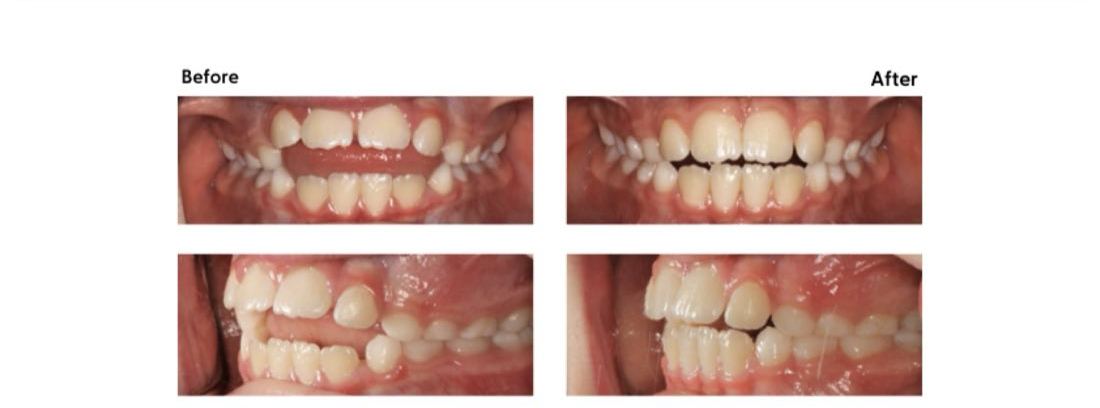
This is a real young Milk Orthodontics patient, shared with their permission. Their open bite closed on its own once a thumb-sucking habit stopped, with no braces or appliances used. It does not always resolve this way, but caught early some open bites do, which is exactly why an early check matters.
What an open bite is
An open bite is when your front teeth do not touch even when your back teeth are closed together, leaving a gap at the front. It is often caused by long-term thumb or dummy sucking, or by the tongue pushing forward, especially in children. The earlier a habit is addressed, the easier the bite is to correct.
Why it happens
The most common cause in children is a thumb, finger or dummy habit, or a tongue that pushes forward when swallowing. In some cases it is down to the way the jaws have grown.
Why it is worth treating
An open bite can make biting into food difficult, affect speech, and put extra wear on the back teeth that do all the work. Correcting it makes eating and speaking easier and protects the teeth.
How we treat it
In children, gently stopping the habit is often the first and most powerful step, and sometimes the teeth close on their own, as in the case above. Where needed, braces or aligners close the bite, and a small appliance can help retrain the tongue.
Open bites can be habit-based or jaw-based, and a specialist can tell you which, and the simplest fix. A free Smile Assessment tells you exactly what is going on and whether treatment is needed. We treat this in children, teens and adults.
Clear pricing, no surprises
The first step is a free Smile Assessment, in the clinic or over Zoom. A full diagnostic work-up with a written plan and exact quote is $390. Simple cosmetic treatment from $7,900, comprehensive specialist treatment from $9,900 with most cases around $10,400, all-inclusive of records, appliances, appointments, retainers and aftercare. Interest-free in-house plans work out around $60 to $76 a week, and family discounts apply for siblings.
Answered honestly
What causes an open bite?
The most common cause is a long-term thumb, finger or dummy sucking habit, or a tongue that pushes against the front teeth when swallowing. Some open bites are related to the way the jaws have grown. A specialist orthodontist can identify the cause and the best way to correct it.
Does thumb sucking really cause an open bite?
Yes, prolonged thumb or dummy sucking is one of the most common causes of an anterior open bite in children, because the constant pressure holds the front teeth apart. The good news is that if the habit stops early enough, the bite can improve on its own, as it did in the case shown above.
What is the best age to treat an open bite?
Addressing the habit early, while a child is still growing, gives the best and simplest results. Open bites can be treated at any age, but habit-related ones are much easier to correct young, so an early assessment is worthwhile.
How much does open bite treatment cost?
Simple cosmetic treatment starts from $7,900 and comprehensive specialist treatment from $9,900, all-inclusive of records, appliances, appointments, retainers and aftercare, including GST. Early habit-focused treatment for a child can be less. You get an exact written quote after your free assessment.
Find out what is causing it
A free 20 minute Smile Assessment, in the clinic or over Zoom. No referral needed, no obligation, just honest specialist advice on your open bite and the simplest way to close it.
See more before and after results, or explore other conditions we treat.